MBA Entrance
 LAW Entrance
 MCA Entrance
 TISS Entrance
 BBA Entrance
 Hotel-Management
 B.ED Entrance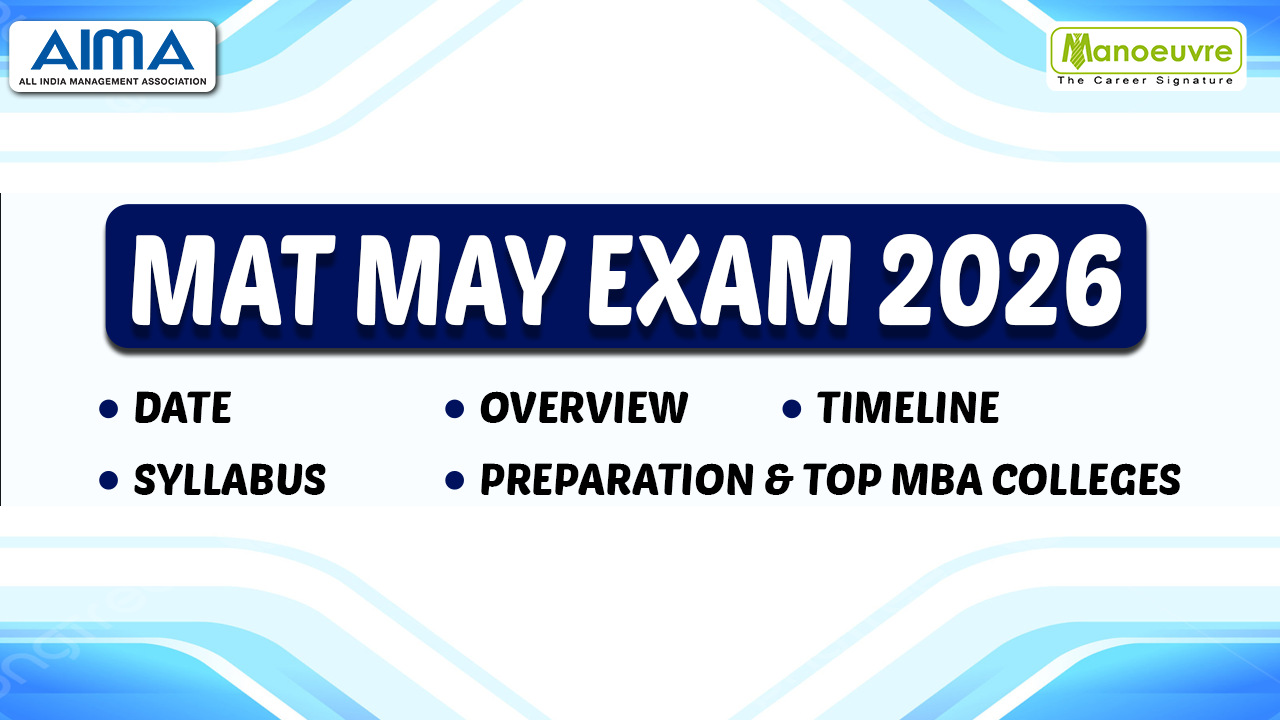
- April 09, 2026
- |
-
0 comments
- Enquiry: +91 88285 81455 |
- Support: +91 88579 45882 |
- 10:00 AM - 07:00 PM

If you’re planning to pursue an MBA in 2026, the MAT exam is one of the most accessible and flexible entrance exams in India. Many students prefer this exam because it is conducted multiple times a year and is accepted by hundreds of MBA colleges.
In this blog, we’ll break everything down in simple language—from exam dates and timeline to syllabus, preparation tips, and top colleges—so you can confidently plan your MBA journey.
MAT (Management Aptitude Test) is a national-level management entrance exam conducted by the All India Management Association (AIMA). It is used for admission to MBA and PGDM programs across India.
One of the biggest advantages of MAT is flexibility. Unlike other MBA exams, it is conducted multiple times a year—February, May, September, and December—giving students multiple chances to improve their scores.
More than 500–800 MBA colleges accept MAT scores, making it a great option for students who want wider opportunities.
Here’s the confirmed schedule for the May session:
● Registration Start: 1 April 2026
● Last Date (PBT): 25 May 2026
● Last Date (CBT): 8 June 2026
● Admit Card (PBT): 28 May 2026
● PBT Exam Date: 31 May 2026
● Admit Card (CBT): 11 June 2026
● CBT Exam Date: 14 June 2026
This clearly shows that MAT in May and June 2026 will be conducted in two formats - Paper Based Test (PBT) and Computer Based Test (CBT).
● Exam Mode: PBT & CBT
● Duration: 120 minutes
● Total Questions: 150
● Sections: 5
● Marking Scheme: +1 (correct), -0.25 (wrong)
1. Language Comprehension
2. Intelligence & Critical Reasoning
3. Mathematical Skills
4. Data Analysis & Sufficiency
5. Economic & Business Environment
Understanding the timeline helps you avoid last-minute stress. Here’s how the process flows:
You need to fill out the form online and pay the fee. Make sure to choose your preferred exam mode.
Download your admit card from the official website before the exam.
You can choose PBT or CBT—or even both for better chances.
Results are usually released within a few weeks after the exam.
Colleges start shortlisting candidates based on MAT scores, followed by GD/PI rounds.
The syllabus is not very complicated and is similar to other MBA exams.
● Reading comprehension
● Vocabulary
● Grammar
● Para jumbles
● Logical reasoning
● Blood relations
● Coding-decoding
● Series
● Arithmetic (profit, loss, time, speed)
● Algebra
● Geometry
● Number system
● Graphs & charts
● Data interpretation
● Caselets
● Current affairs
● Business news
● Basic economics concepts
Good news: The syllabus is consistent every year, so once you prepare, it helps in multiple attempts.
Preparation doesn’t have to be complicated. Even 2–3 months of focused study can help you score well.
Focus on clearing fundamentals, especially in maths and reasoning.
● 2–3 hours daily (minimum)
● Divide time section-wise
● Keep weekly revision
Mocks help you:
● Understand exam pattern
● Improve speed
● Build confidence
If maths is weak, give it extra time. If English is tough, practice reading daily.
Revision is key. Without revision, you’ll forget concepts quickly.
● Cover full syllabus
● Focus on basics
● Practice sectional questions
● Attempt mock tests
● Analyze mistakes
● Improve speed and accuracy
Here are some popular MBA colleges that accept MAT scores:
● Amity University
● Christ University
● Jain University
● Jaipuria Institute of Management
● Institute of Public Enterprise (IPE)
● VIT Business School
● SRM University
These colleges offer good programs, and some also provide decent placement opportunities.
This is a common question among students.
The May session is useful because:
● It gives you another chance if you missed earlier exams
● You can improve your score
● Some colleges still accept May scores
However, keep in mind that many top colleges may close admissions earlier, so options may be slightly limited.
● Don’t wait for the “perfect time” to start
● Focus on consistency, not long hours
● Practice mocks regularly
● Stay updated with current affairs
Conclusion
The MAT May exam is a great opportunity for MBA aspirants who want flexibility and multiple chances. With a clear understanding of the exam pattern, syllabus, and timeline, you can prepare smartly and achieve a good score.
If you stay consistent and follow a structured plan, cracking MAT 2026 is absolutely achievable—even if you’re starting from scratch.

The MAT May 2026 exam will be conducted in two modes. The Paper-Based Test (PBT) is expected on 31 May 2026, while the Computer-Based Test (CBT) will be held around 14 June 2026.
Yes, you can appear for both formats. Many students choose this option to improve their scores and increase their chances of getting shortlisted by colleges.
MAT is conducted four times a year—in February, May, September, and December—giving multiple opportunities to candidates.
4. What are the eligibility requirements for MAT 2026?
Candidates must hold a bachelor’s degree in any discipline from a recognized university. Final-year students can also apply.
MAT is generally considered moderate in difficulty. It is easier compared to exams like CAT but still requires proper preparation and time management.
The MAT exam includes 150 multiple-choice questions distributed across five sections.
Yes, there is negative marking. For every wrong answer, 0.25 marks are deducted.
All sections are important, but Mathematical Skills and Data Analysis often have a bigger impact on your overall score.
With consistent effort, 2–3 months of preparation is usually enough for most students to score well in MAT.
Many reputed colleges accept MAT scores, including Amity University, Christ University, Jain University, and Jaipuria Institute of Management.
Latest Blog