MBA Entrance
 LAW Entrance
 MCA Entrance
 TISS Entrance
 BBA Entrance
 Hotel-Management
 B.ED Entrance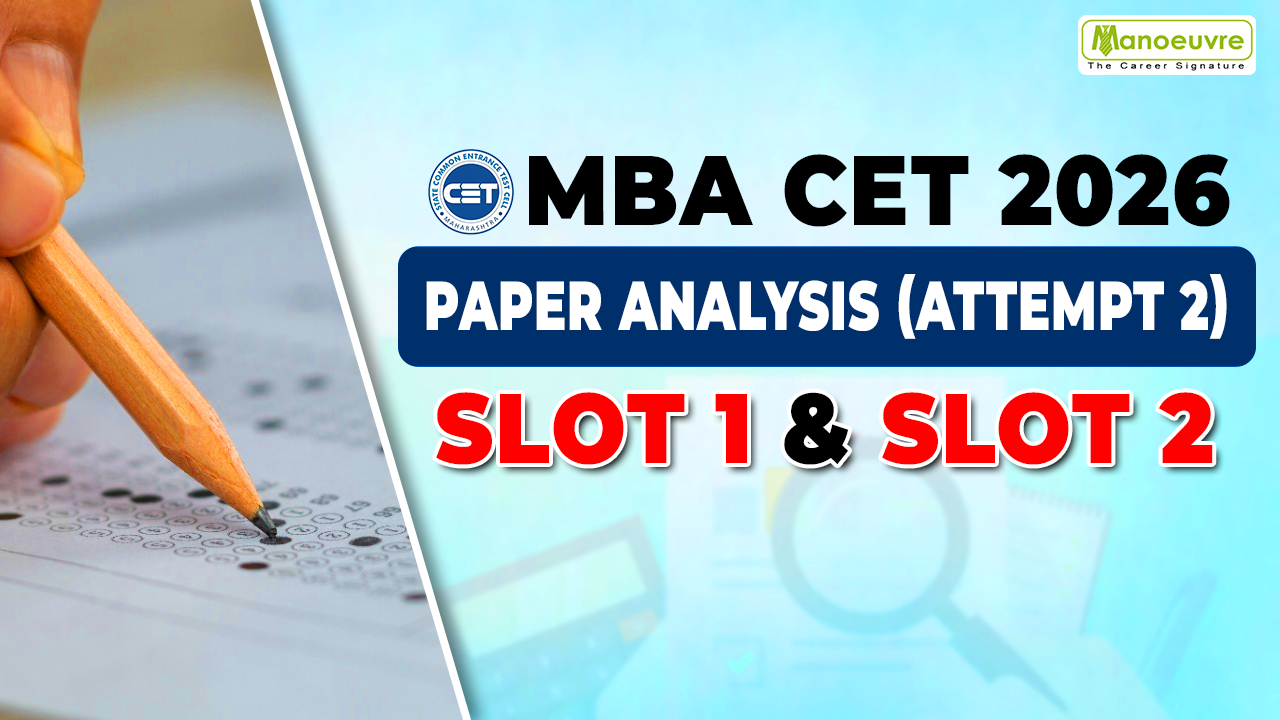
- May 09, 2026
- |
-
0 comments
- Enquiry: +91 88285 81455 |
- Support: +91 88579 45882 |
- 10:00 AM - 07:00 PM

The MAH MBA CET 2026 Attempt 2 examination has concluded successfully, and candidates across Maharashtra are now looking for a detailed analysis of Slot 1 and Slot 2. Based on student reactions and expert reviews, both slots were moderately difficult, with a noticeable shift in question patterns compared to Attempt 1.
This detailed analysis covers section-wise difficulty, important topics asked, overall paper trends, expected good attempts, and cut-off predictions for top MBA colleges.

The Attempt 2 paper maintained the traditional MAH MBA CET structure with four major sections:
● Logical Reasoning
● Abstract Reasoning
● Quantitative Aptitude
● Verbal Ability & Reading Comprehension
One of the biggest highlights of Attempt 2 was the absence of seating arrangement questions in both slots, which surprised many candidates. The paper focused more on traditional logic and calculation-intensive arithmetic questions.
The overall difficulty level of Slot 1 was Moderate. Compared to Attempt 1, some sections were slightly more time-consuming and analytical.
Logical Reasoning Analysis – Slot 1
The Logical Reasoning section in Slot 1 was dominated by traditional reasoning topics instead of arrangement-based puzzles.
Moderate
● Syllogism
● Alphabet Test
● Coding-Decoding
● Number & Letter Series
● Blood Relations
● Ranking
● Direction Sense
● Venn Diagrams
● Clock & Calendar
● Assumption and Fact-Based Questions
No seating arrangement questions appeared in this slot, which was unexpected for many students.
Most candidates found the section manageable but slightly lengthy because of conceptual logic questions.
This section was considered tougher compared to Attempt 1.
Moderate to Difficult
● Pattern Completion
● Figure Classification
● Mirror Images
● Triangle Counting
● Image-Based Pattern Questions
Pattern-based questions required careful observation and consumed more time than expected.
The Quant section was calculation-heavy but solvable for well-prepared students.
Moderate
● Average
● Geometry
● Mensuration
● Percentage
● Ratio & Proportion
● Time and Work
● Mixture & Allegation
● Number Series
● Simplification
● Probability
● Partnership
● Problems on Ages
● Time-Speed-Distance
● Data Interpretation
Arithmetic dominated the paper, while Data Interpretation sets were manageable with proper calculations.
The Verbal section was comparatively easier and became a scoring area for many candidates.
Easy to Moderate
● Reading Comprehension
● Sentence Improvement
● Error Detection
● Synonyms & Antonyms
● Fill in the Blanks
● Idioms & Phrases
● One Word Substitution
● Spell Check
● Direct & Indirect Speech
Around 15–20 RC-based questions appeared in the paper.
Performance Level | Expected Score Range |
Excellent Attempt | 155+ |
Good Attempt | 130–150 |
Average Attempt | 100–125 |
Students with strong accuracy in Quant and Logical Reasoning are expected to score higher percentiles.
Slot 2 was comparatively lengthier and more calculation-intensive than Slot 1. Many students reported difficulty in completing the paper within the time limit.
Logical Reasoning Analysis – Slot 2
The reasoning section followed a completely different pattern from previous years.
Moderate to Difficult
● No Linear Arrangement Questions
● No Circular Arrangement Questions
● No Distribution-Based Puzzles
● Input-Output
● Syllogism
● Classification
● Coding-Decoding
● Number Series
● Venn Diagram
● Blood Relations
● Direction Sense
● Data Sufficiency
● Assertion & Reason
● Miscellaneous Logic-Based Questions
Clock and Calendar questions shifted from Logical Reasoning to Quantitative Aptitude.
This section turned out to be one of the most scoring areas in the paper.
Easy to Moderate
● Visual Analogy
● Pattern Completion
● Odd Man Out
● Figure Classification
● Cubes & Dice
● Image-Based Questions
Candidates who practiced visual reasoning regularly found this section easy to solve quickly.
This section was the most time-consuming part of the examination.
Moderate but Lengthy
● Time-Speed-Distance
● Percentage
● Mixture & Alligation
● Time & Work
● Profit & Loss
● Data Interpretation
● Number Series
● Simplification
● Clock-Based Questions
Calculation speed played a major role in overall performance.
The Verbal section maintained a balanced structure with grammar and vocabulary questions.
Easy to Moderate
● 4 RC Passages
● Around 20 RC Questions
● 3 lengthy passages and 1 short passage
● Error Detection
● Active-Passive Voice
● Direct & Indirect Speech
● Synonyms & Antonyms
● One Word Substitution
● Fill in the Blanks
● Spell Check
Based on the overall paper difficulty and student feedback, experts are expecting the following score ranges for top colleges.
College Category | Expected Score |
JBIMS Mumbai | 160+ |
Top MBA Colleges | 140–160 |
Safe Score for Top 20 Colleges | 130+ |
Around 99.96 percentile is expected for admission into top institutes like Jamnalal Bajaj Institute of Management Studies.
Several noticeable changes were seen in the MAH MBA CET 2026 Attempt 2 paper pattern:
● Absence of seating arrangement questions
● Higher focus on traditional reasoning
● Arithmetic-heavy Quant section
● More calculation-intensive DI sets
● Strong emphasis on RC passages in Verbal Ability
These shifts indicate that the exam pattern is evolving toward conceptual understanding and speed-based solving.
Candidates appearing in future management entrance exams can learn several lessons from Attempt 2.
Topics like Percentage, Time & Work, Mixture, and Profit & Loss dominated the paper.
Fast calculations became crucial, especially in Quantitative Aptitude and DI.
Since arrangement puzzles were absent, students with strong command over basic reasoning topics had an advantage.
Avoid spending too much time on lengthy questions. Smart question selection played a major role in maximizing attempts.
The MAH MBA CET 2026 Attempt 2 Slot 1 and Slot 2 papers were moderate overall but lengthy in nature. While Slot 1 was balanced and manageable, Slot 2 was more calculation-oriented and time-consuming.
Candidates with strong fundamentals in arithmetic, logical reasoning, and reading comprehension are expected to perform well. The absence of arrangement puzzles was the biggest surprise of the examination and may influence future exam strategies for MBA aspirants.
Students should now focus on score estimation, percentile prediction, and college shortlisting for the upcoming admission process.
9. What is considered a safe score for top MBA colleges through MAH MBA CET 2026?
A score between 130 and 160 is expected to be considered safe for admission into many top MBA colleges participating in the CAP process.
10. What should candidates do after the MAH MBA CET 2026 exam?
Candidates should begin score analysis, percentile prediction, college shortlisting, and preparation for the MBA admission counselling and CAP rounds.

Latest Blog