 MBA Entrance
 LAW Entrance
 MCA Entrance
 TISS Entrance
 BBA Entrance
 Hotel-Management
 B.ED Entrance
- Enquiry: +91 88285 81455 |
- Support: +91 88579 45882 |
- 10:00 AM - 07:00 PM


30 Apr 2026
0 comments
MAH BBA CET 2026 Exam Analysis Day 2: Shift 3 & Shift 4 Detailed Review The MAH BBA CET 2026 Day 2 exam analysis for Shift 3 and Shift 4 brings valuable insights for aspirants evaluating their performance and planning next steps. Compared to Day 1, the overall paper leaned slightly towards the tougher side, with a noticeable increase in arithmetic-based questions and logical reasoning complexity.If you appeared for these shifts—or are preparing for upcoming sessions—this detailed breakdown will help you understand the exam pattern, difficulty level, and expected cut-off trends. Overall Difficulty Level: Day 2 (Shift 3 & 4) The second day of the exam followed a similar structure but introduced higher complexity, particularly in quantitative and reasoning sections.● Shift 3: Moderate to slightly difficult● Shift 4: Reported as the toughest among all shifts● Key Observation: Increased focus on arithmetic and analytical reasoningStudents found that while English and GK sections remained manageable, the math-heavy approach significantly influenced the overall difficulty. Sectional Analysis of MAH BBA CET 2026 Day 2 Mathematics & Logical ReasoningThis section stood out as the most challenging component in both shifts.● Arithmetic dominated with 7–8 questions● Topics included:○ Percentages○ Profit & Loss○ Ratio & Proportion○ Simple & Compound Interest● Logical reasoning included:○ Traditional reasoning questions○ Critical reasoning○ Two arrangement-based sets (linear/circular)The increased weightage of numerical problems made this section time-consuming and required strong conceptual clarity.Difficulty Level: Moderate to DifficultVerdict: Time management was crucial; accuracy mattered more than attempts. English LanguageThe English section maintained a balanced and predictable pattern.● Reading Comprehension passages tested interpretation skills● Grammar-based questions included:○ Fill in the blanks○ Spell check○ Direct & Indirect Speech○ Active & Passive VoiceStudents with a solid grasp of grammar rules found this section relatively easier.Difficulty Level: Easy to Moderate Verdict: Scoring opportunity for well-prepared candidates. General Knowledge & Current AffairsThis section had a balanced distribution and did not heavily rely on static GK.● Mix of:○ Current affairs○ Basic static knowledge● Questions were straightforward and not overly trickyStudents who stayed updated with recent events had an advantage.Difficulty Level: ModerateVerdict: Consistent with expectations; not overly challenging. Computer LiteracyThe computer section followed a familiar pattern seen in earlier shifts.● Basic concepts tested● No unexpected or advanced questions● Topics included fundamentals of computers and applicationsDifficulty Level: Easy to ModerateVerdict: One of the more scoring sections in the paper. Expected Cut-offs & Normalization Impact One of the most important aspects of Day 2 is the expected normalization effect.Normalization TrendSince Shift 4 was the toughest, normalization is expected to play a significant role.● Students in Shift 3 and 4 may achieve higher percentiles with relatively lower raw scores● Difficulty level adjustment will benefit candidates from tougher shiftsExpected Cut-offs● Top colleges (like Jai Hind College): Likely above 99 percentile● Mid-tier colleges: Slight variation based on normalization● Overall trend: Lower marks may still yield competitive percentilesThis makes it essential for candidates not to judge performance solely based on raw scores. Key Highlights from Day 2 Analysis ● Arithmetic had higher weightage than expected● Logical reasoning included arrangement-based sets● English remained grammar-focused and manageable● GK section was balanced, not overly static● Computer section stayed consistent across shifts● Shift 4 emerged as the toughest session Post-Exam Strategy for Aspirants Now that the exam is over, the next phase is equally important—college selection and career planning.1. Focus on College Quality, Not Just LocationAvoid choosing colleges purely based on proximity. Look for:● Placement records● Faculty quality● Industry exposure2. Consider Integrated ProgramsInstitutes offering integrated master's programs can provide long-term academic benefits.3. Research Top InstitutionsSome of the well-known options include:● Jai Hind College● Lexicon Institute (Pune)● Amity University4. Prepare for Further RoundsSome colleges may conduct:● Personal Interviews (PI)● Written Ability Tests (WAT)Stay prepared for the next stage. Final Thoughts The MAH BBA CET 2026 Day 2 Shift 3 & 4 analysis clearly shows a shift towards a more analytical and calculation-heavy paper pattern. While English and GK provided relief, the increased emphasis on arithmetic and reasoning made the exam more competitive.If you appeared in these shifts, normalization is likely to work in your favor. Instead of stressing over raw scores, focus on percentile predictions and upcoming admission processes. FAQs 1. Which was the toughest shift in MAH BBA CET 2026 Exam Day 2?Shift 4 was reported as the toughest among all sessions.2. Was the math section difficult in MAH BBA CET 2026 Day 2 Shift 3 and 4?Yes, it had higher arithmetic weightage, making it the most challenging section.3. How was the English section in MAH BBA CET 2026 Day 2?It was manageable, especially for students strong in grammar.4. Did GK focus more on static or current affairs MAH BBA CET 2026 Exam Day 2?It had a balanced mix of both, without heavy emphasis on static GK.5. Will normalization benefit Shift 3 and 4 students?Yes, due to higher difficulty, normalization may result in better percentiles.6. What is the expected cut-off for top colleges in MAH BBA CET 2026 Exam?Top institutes like Jai Hind College may have cut-offs above the 99 percentile.7. How many arithmetic questions were asked in MAH BBA CET 2026 Exam Day 2?Approximately 7 to 8 questions were based on arithmetic.8. Was the computer section tough in MAH BBA CET 2026?No, it was consistent and relatively easy compared to other sections.9. Should I worry about low raw scores in Shift 4?Not necessarily, as normalization can significantly improve your percentile.10. What should I do after the MAH BBA CET 2026 exam?Focus on college research, admission processes, and interview preparation.
28 Apr 2026
0 comments
MAH BBA CET 2026 Exam Analysis Day 1: Shift 1 & Shift 2 Detailed Review The MAH BBA CET 2026 Day 1 exam has set a clear tone for candidates appearing in the upcoming shifts. With a balanced mix of logic, language skills, general awareness, and computer fundamentals, the paper tested conceptual clarity more than extreme difficulty.This detailed analysis of Shift 1 and Shift 2 will help you understand the exam pattern, difficulty level, and scoring opportunities so you can refine your strategy accordingly. Overall Exam Overview Day 1 of the exam maintained a consistent difficulty level across both shifts, which is a positive sign for aspirants.● Shift 1: Moderate● Shift 2: Easy to Moderate● Trend: Stable difficulty, minimal surprises● Question Pattern: Largely predictable with repetition from mock testsCandidates who practiced well-structured mocks and revised fundamentals found the paper manageable. Shift 1 Detailed Analysis Difficulty LevelThe overall paper was moderate, closely matching the level of standard mock test series. It was neither too challenging nor too easy, making it a fair attempt for well-prepared students. Section-wise Analysis 1. Logical ReasoningThis section leaned heavily toward traditional logic-based questions, with no presence of complex puzzles or arrangements.Key Topics Covered:● Coding-Decoding (3–4 questions)● Alphabet Series (2–3 questions)● Syllogism (2 questions)● Series (2 questions)● Maths-based Logic (Percentages, Time-Speed-Distance) – 2–3 questions● Ranking (1 question)● Clock & Calendar (1 question)● Analogy (1 question)● Assertion & Reason (1 question)Key Insight:The absence of puzzles and blood relations made this section relatively straightforward and scoring. 2. English LanguageThe English section focused on grammar and comprehension, making it a high-scoring area.Key Topics Covered:● Reading Comprehension – 2 sets (10 questions)● Idioms & Phrases (3–4 questions)● Synonyms & Antonyms (2–3 questions)● Fill in the Blanks (2 questions)● Sentence Improvement (2 questions)● Error Detection (1 question)Key Insight:Reading comprehension played a crucial role. Students with good reading speed had a clear advantage. 3. General KnowledgeThe GK section showed a balanced distribution.● Static GK: ~50%● Current Affairs: ~50%Key Insight:Current affairs had slightly higher prominence compared to previous years, making regular updates essential. 4. Computer LiteracyThis section was easy and scoring, with direct questions.Key Topics Covered:● MS Office basics● Internet fundamentals● Operating systems● Keyboard shortcutsKey Insight:Most questions were straightforward and based on basic concepts, making it a scoring booster. Expected Good Score● Average Good Score: 80–85● Top Score Range: 90+ Shift 2 Detailed Analysis Difficulty LevelShift 2 was rated easy to moderate, with some candidates finding it slightly trickier than Shift 1 but still manageable overall. Key Trends● Questions repeated from previous exams and mock tests● Stable difficulty level across sections● Predictable question pattern Section-wise Breakdown1. Logical Reasoning & Quantitative AptitudeThis section saw slight variations compared to Shift 1.Key Changes:● Blood Relations included● Clock & Calendar removed● Increased focus on arithmetic logicImportant Topics:● Coding-Decoding● Syllogism & Venn Diagrams● Blood Relations● BODMAS-based questions● Equation-based problemsKey Insight:Puzzles and data interpretation were mostly absent, keeping the section simpler. 2. English LanguageThe level remained consistent with Shift 1.Focus Areas:● Reading Comprehension● Grammar (Error Detection, Sentence Correction)● TensesKey Insight:Candidates preparing for upcoming shifts should revise:● Active & Passive Voice● Direct & Indirect Speech 3. General Knowledge & Current Affairs● Equal weightage between static and current topics● Many questions repeated from mock testsKey Insight:Practicing mock-based GK proved highly beneficial. 4. Computer LiteracyThis section stood out due to direct repetition of questions.Key Insight:Students who practiced mock tests had a major advantage here. Shift 1 vs Shift 2 ComparisonSectionShift 1Shift 2DifficultyModerateEasy to ModerateLogical ReasoningNo Blood Relations, includes ClockIncludes Blood Relations, no ClockQuantBasic arithmetic logicAdded BODMAS & equationsEnglishGrammar + RC heavySimilar patternGKBalancedBalanced with repeatsComputerEasyVery easy with repeats Key Takeaways from Day 1 1. Consistency is KeyThe exam maintained a similar difficulty level across shifts, reducing unpredictability.2. Mocks Played a Crucial RoleMany questions were directly or indirectly repeated from mock tests.3. Traditional Logic DominatesNo heavy puzzles or DI sets were seen, making preparation more predictable.4. Computer Literacy is a Scoring SectionBasic knowledge and revision can secure full marks here.5. English Section is ScoringFocus on reading comprehension and grammar fundamentals. Strategy for Upcoming Candidates If you are appearing in the next shifts, here’s what you should do:1. Focus on Mock TestsRevise previously attempted mock tests thoroughly, especially the first few sets.2. Strengthen Computer KnowledgeRevise:● MS Office basics● Shortcut keys● Internet fundamentals3. Prioritize English● Practice reading comprehension daily● Revise grammar rules● Focus on sentence correction4. Master Logical Reasoning● Practice coding-decoding, syllogisms, and series● Focus on arithmetic-based logic5. Revise GK Smartly● Cover both static GK and recent current affairs● Focus on frequently asked topics Final Thoughts The MAH BBA CET 2026 Day 1 exam reflects a well-balanced and student-friendly paper pattern. With moderate difficulty and a predictable structure, students who focused on fundamentals and mock practice were able to perform well.For upcoming candidates, the key lies in smart revision, mock analysis, and focusing on high-weightage topics. If the trend continues, consistent preparation can easily lead to a high score in the exam.Stay focused, revise strategically, and make the most of the insights from this analysis to boost your performance in the upcoming shifts. FAQs 1. What was the overall difficulty level of BBA CET Day 1 exam?The overall difficulty level ranged from moderate to easy-to-moderate across both shifts, making it manageable for well-prepared candidates. 2. Was there any major difference between BBA CET Day 1 Shift 1 and Shift 2?Yes, Shift 2 included blood relation questions and excluded clock-based questions, while Shift 1 had the opposite pattern. 3. Which section was the most scoring in BBA CET Day 1 Exam?Computer Literacy and English Language were the most scoring sections due to direct and predictable questions. 4. Were questions repeated from previous exams or mock tests in BBA CET Day 1 Exam?Yes, many questions—especially in Computer Literacy and GK—were repeated from previous exams and mock tests. 5. How important was Reading Comprehension in BBA CET Day 1 exam?Reading Comprehension was highly important, with around 10 questions, making it a key scoring area. 6. What type of questions were asked in BBA CET Day 1 Exam Logical Reasoning?The section focused on traditional logic topics like coding-decoding, syllogisms, series, and basic arithmetic-based reasoning. 7. Was General Knowledge more static or current-based?The GK section had a balanced mix of both static GK and current affairs. 8. What is considered a good score in BBA CET 2026 exam?A score between 80–85 is considered good, while 90+ is expected for top performers. 9. Were puzzles and data interpretation questions asked in BBA CET Day 1 Exam?No major puzzle or data interpretation questions were reported in either shift, making the paper more straightforward. 10. What should candidates focus on for upcoming shifts?Candidates should focus on mock test revision, computer fundamentals, reading comprehension, grammar, and traditional reasoning topics.
24 Apr 2026
0 comments
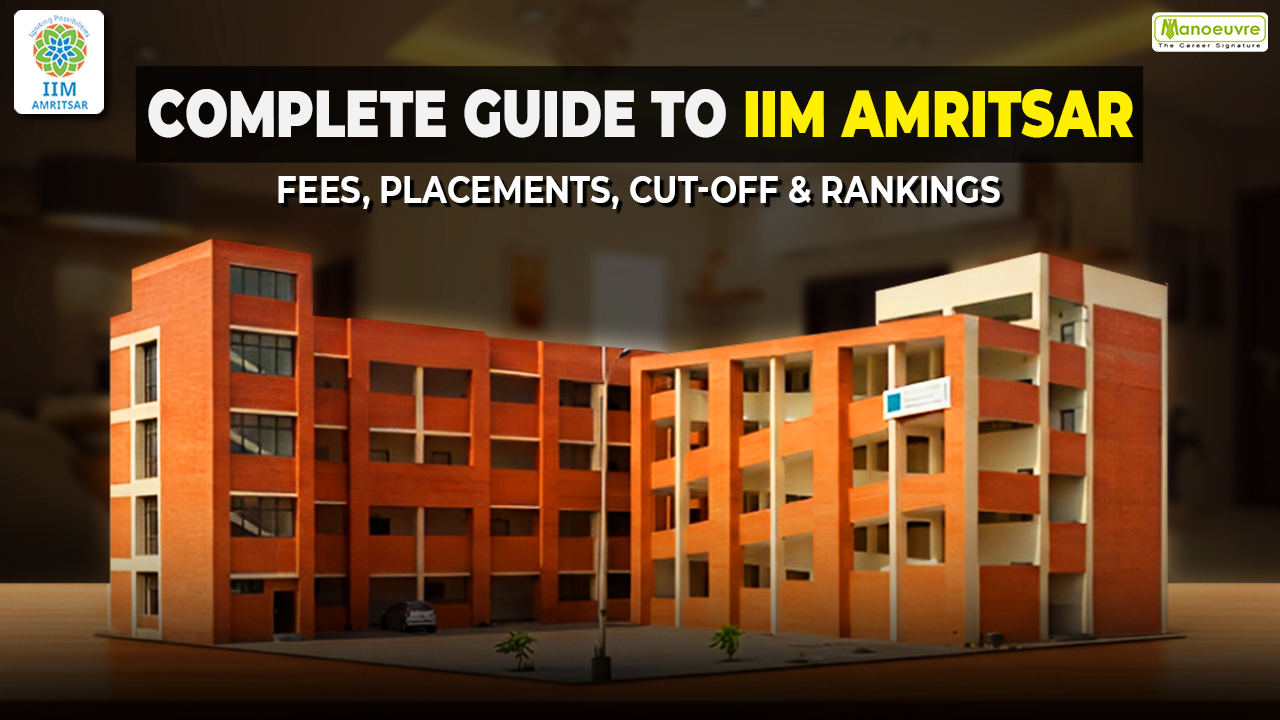
All About IIM Amritsar Getting into a good management institution after Class 12 is something a lot of students think about, but very few know where to actually start. IIM Amritsar is one of those names that keeps coming up in conversations — and for good reason. Set up in 2015, it is the 15th IIM in India and has moved pretty quickly in terms of building its academic reputation. If you are someone who wants the IIM tag but does not want to wait until after graduation to chase it, this place is worth your time to research properly.This guide is put together to give you a clear, no-fluff picture of what IIM Amritsar actually offers — the programme structure, what you will pay, how admissions work, and what kind of jobs students have been landing. A Quick Look at IIM Amritsar The institute runs from two locations in Punjab. The administration sits at the Punjab Institute of Technology, while classes happen at the Manawala campus. It is not a metro-based IIM, but that has not stopped it from building a decent academic standing. In the NIRF 2025 rankings, it came in at 64th, which for an institution that is barely a decade old, is a reasonable milestone.The programme that most students ask about is the five-year IPM — the Integrated Programme in Management. That is the main offering for students entering after Class 12, and it is what this guide focuses on. What Is the IIM Amritsar IPM? The IIM Amritsar IPM is a five-year programme that gives you two degrees — a Bachelor's and an MBA — under one roof. Here is how the years are split:● Years 1 to 3 — You study for a Bachelor of Science (BS) in Quantitative Finance and Economics● Years 4 and 5 — You move into the MBA phaseThere is also an exit option. If after three years you decide you want to step out, you leave with a BS degree. Most students stay for the full five years to get the MBA, but it is good to know that option exists.The programme leans heavily on numbers — quantitative methods, finance, and economics form the core. So if you genuinely enjoy Maths and are interested in how finance works, the curriculum will feel like a natural fit. If you are someone who prefers purely people or communication-driven subjects, you might want to evaluate whether this structure suits you before applying. Who Can Apply? The eligibility conditions are fairly standard, but a few points are worth noting carefully:● You must not be older than 20 years as of August 1, 2026● You should have completed Class 12 in 2025 or be appearing in 2026● Mathematics or Applied Mathematics in Class 12 is compulsory — there is no way around this● General category students need at least 60% in both Class 10 and 12● SC, ST, and PwD students need 55% in bothThe Maths requirement catches some students off guard, especially those who switched to a non-Maths stream in Class 11. So if you are currently in Class 10 and thinking ahead, keep this in mind when choosing your subjects. The Admission Process and IIM Amritsar Cut Off IIM Amritsar does not hold its own entrance exam. It uses IPMAT Indore scores for shortlisting, which is actually convenient because you are preparing for one exam that opens doors to multiple IIM IPM programmes.How the IPMAT Is StructuredSectionFormatQuestionsTimeQuantitative AbilityMCQ3040 minsQuantitative AbilityShort Answer1540 minsVerbal AbilityMCQ4540 minsOne thing worth highlighting — the Short Answer section for Quant has no negative marking. That means you should attempt every question in that section without hesitation, even if you are not fully confident.How the Final Selection WorksGetting a good IPMAT score is necessary but not sufficient. The IIM Amritsar cut off process considers three things:● Aptitude Test Score: 70% weightage● Personal Interview: 25% weightage● Gender Diversity: 5% weightageThe interview round matters more than students often realise. Clearing the score threshold gets you to the interview, but that 25% can genuinely shift your rank. Prepare for it seriously.Dates to Save for 2026● IPMAT Indore Registration closes: March 14, 2026● IIM Amritsar Application deadline: April 6, 2026● IPMAT Exam: May 4, 2026Note that the IIM Amritsar application deadline is separate from the IPMAT registration deadline. You need to register for the exam first and then separately apply to IIM Amritsar before April 6. IIM Amritsar Fees: The Full Breakdown Let us be straightforward about this — the IIM Amritsar fees are not cheap. The total cost across five years comes to roughly ₹39.25 Lakhs. Here is how it breaks down year by year:BS Phase — Years 1 to 3● Year 1: ₹6.25 Lakhs● Year 2: ₹5.75 Lakhs● Year 3: ₹5.75 Lakhs● Total for BS: approximately ₹17.75 LakhsMBA Phase — Years 4 and 5● Year 4: ₹11 Lakhs● Year 5: ₹10.5 Lakhs● Total for MBA: approximately ₹21.5 LakhsThe MBA years are noticeably more expensive than the BS years — that is fairly typical for IIM programmes. Most families plan education loans around this structure, and several banks offer loans specifically for IIM admissions, so the financial path is not uncharted territory. IIM Amritsar Placements: What Students Are Actually Getting This is the section most people scroll to first, and understandably so. Here is what the IIM Amritsar placement data looks like:MetricFigureHighest Package₹25.86 LPAAverage Package (Top 20%)₹19.11 LPAMedian Package (Top 20%)₹18 LPAThe IIM Amritsar average package for the top 20% of graduates is ₹19.11 LPA, with the median sitting at ₹18 LPA. The highest package recorded is ₹25.86 LPA.A few things to keep in mind when reading these numbers — these figures represent the top fifth of the batch. For a complete picture, it is worth looking at average packages across the full batch when that data is published. That said, for an IIM that is still in its first decade, these are genuinely solid numbers, and the trend has been moving upward.Recruiters from consulting, finance, FMCG, and tech sectors have been coming to campus, and as more alumni move into senior roles, the recruiter network typically grows stronger each year. So Should You Apply? Honestly, that depends on what you are looking for. If you want to lock in your MBA early, avoid the CAT rat race later, and are comfortable with a quantitative, finance-heavy curriculum, IIM Amritsar makes a lot of sense. The IIM brand still carries weight, the programme gives you two degrees, and the placement trajectory is heading in the right direction.If your goal is purely a top-5 IIM or you are unsure about committing to management at the Class 12 stage, it is worth thinking through more carefully before applying. The five-year commitment and the fee structure are both significant, and clarity of purpose going in makes a real difference.For students who have done the thinking and are ready to move, make sure you are registered for IPMAT before March 14 and have your IIM Amritsar application sorted by April 6. That timeline comes up faster than it seems. Frequently Asked Questions About IIM Amritsar 1. What is the total fee for the IIM Amritsar IPM programme?The total IIM Amritsar fees for the five-year Integrated Programme in Management is approximately ₹39.25 Lakhs. This includes around ₹17.75 Lakhs for the first three years (BS phase) and ₹21.5 Lakhs for the final two years (MBA phase). Students can explore education loan options from banks that specifically support IIM admissions. 2. Does IIM Amritsar conduct its own entrance exam?No, IIM Amritsar does not hold a separate entrance test. Admissions to the IPM programme are based on IPMAT Indore scores. After clearing the score threshold, shortlisted candidates are called for a Personal Interview, which carries 25% weightage in the final selection. 3. What is the IIM Amritsar average package for placements?As per the latest placement data, the IIM Amritsar average package for the top 20% of the batch is ₹19.11 LPA, with a median of ₹18 LPA. The highest package recorded stands at ₹25.86 LPA. Sectors like consulting, finance, FMCG, and technology are among the key recruiters on campus. 4. What is the IIM Amritsar cut off process?IIM Amritsar does not publish a fixed cut off score, but the selection is based on three parameters — IPMAT Aptitude Test Score (70%), Personal Interview (25%), and Gender Diversity (5%). Scoring well in IPMAT gets you to the interview stage, after which the combined score determines your final selection. 5. Is Mathematics compulsory for IIM Amritsar IPM eligibility?Yes, Mathematics or Applied Mathematics in Class 12 is a mandatory requirement for applying to the IIM Amritsar IPM programme. Students from non-Maths streams are not eligible, so this is something to plan for as early as Class 10 when choosing subjects. 6. What degree do you get after completing the IIM Amritsar IPM?On completing all five years, students receive an MBA degree from IIM Amritsar. There is also an exit option after three years for students who choose not to continue, in which case they are awarded a Bachelor of Science (BS) degree in Quantitative Finance and Economics. 7. What is the NIRF ranking of IIM Amritsar?IIM Amritsar holds the 64th rank in the NIRF 2025 rankings. For an institution established in 2015, this is a strong indicator of its academic growth and increasing recognition within India's higher education system. 8. When is the IIM Amritsar application deadline for 2026?The IIM Amritsar application deadline for the 2026 intake is April 6, 2026. Students must also register for IPMAT Indore separately before March 14, 2026, as the two deadlines are independent of each other. The IPMAT exam itself is scheduled for May 4, 2026. 9. What is the age limit for applying to IIM Amritsar IPM?Candidates must not be older than 20 years as of August 1, 2026 to be eligible for the IPM programme. This applies to all categories. Students who have taken a gap year after Class 12 should verify their age eligibility before applying. 10. Where is IIM Amritsar located and how is the campus?IIM Amritsar operates from two facilities in Punjab. The administrative office is located at the Punjab Institute of Technology, while academic sessions are conducted at the Manawala campus. Though it is not based in a metro city, the campus infrastructure supports the academic needs of the programme, and being in Punjab gives students a relatively affordable cost of living compared to metro-based IIMs.
22 Apr 2026
0 comments
Complete Guide to MAH CET IPM, BBA & BMS 2027–2028 Preparation Preparing for competitive management entrance exams right after school has become increasingly important for students aiming to secure admission into top colleges. Exams like MAH CET, IPM, BBA, and BMS entrances are highly competitive, and a well-structured preparation strategy can make all the difference.This guide will walk you through a complete step-by-step plan to prepare effectively for the 2027–2028 cycle, ensuring you stay ahead of the competition and maximize your chances of selection. Why Early Preparation Matters One of the biggest mistakes students make is starting their preparation too late. Many wait until Class 12, which creates unnecessary pressure due to board exams and entrance tests happening simultaneously.Starting early—ideally in Class 10 or 11—gives you a significant advantage. You get more time to understand concepts, practice thoroughly, and build confidence gradually. Early preparation also increases your chances of clearing exams in your first attempt, avoiding the need for a drop year.With lakhs of students competing for limited seats in top colleges, beginning early is not just helpful—it’s strategic. Day 1: Build Strong Foundations Before jumping into advanced topics, it’s essential to strengthen your basics. A solid foundation ensures faster learning and better retention later.1. Master CalculationsSpeed and accuracy in calculations are crucial. Start with:● Tables from 1 to 20● Squares up to 30● Cubes up to 20● Fraction to percentage conversionsThese basics will significantly improve your performance in quantitative sections.2. Develop a Reading HabitReading daily improves comprehension, vocabulary, and awareness. Focus on:● Editorials and front-page news● Digital reading on a laptop or tablet (to match exam format)Consistent reading enhances both verbal ability and general awareness.3. Improve VocabularyA strong vocabulary is essential for verbal sections. One of the most recommended resources is the book Word Power Made Easy, which helps build word knowledge systematically.4. Strengthen Grammar BasicsFocus on fundamental grammar rules:● Nouns and Pronouns● Verbs and Tenses● Adjectives and Adverbs● PrepositionsClear grammar concepts will improve accuracy in language-based questions. Understanding the Exam Structure Different entrance exams have varying difficulty levels and syllabus requirements. It’s essential to identify the areas where you should concentrate your efforts.General-Level ExamsThese exams typically cover:● Basic Mathematics (Class 8–10 level)● Logical Reasoning● Verbal Ability● General KnowledgeThey are designed to test fundamental aptitude rather than advanced concepts.Advanced-Level ExamsSome exams require deeper preparation:● Higher-level Mathematics (Class 11–12 topics)● Data Interpretation● Advanced Logical ReasoningThese exams are more competitive and demand conceptual clarity.Special Sections to PrepareCertain exams include unique sections:● Computer fundamentals for Maharashtra-based exams● Basic accounting knowledge for some university entrancesBeing aware of these sections early helps you prepare without last-minute stress. The “Multiple Exam Strategy” Relying on a single exam is risky. A smarter approach is to prepare for multiple entrances simultaneously.Aim to target at least 3 to 4 exams. This increases your chances of getting into a top college and reduces dependency on a single result.Some key exams to consider include:● IPMAT● NPAT● SET● MAH BBA CET● CUET UGThis approach ensures broader opportunities across top institutions. Top Colleges You Should Target Your preparation should always be aligned with clear goals. Some of the most reputed colleges include:IIMs Offering IPM Programs● Indian Institute of Management Indore● Indian Institute of Management Rohtak● Indian Institute of Management RanchiTop BBA/BMS Colleges● NMIMS● Symbiosis International University● Christ University● St. Xavier's College● Jai Hind CollegeSetting these targets helps you stay motivated and focused throughout your preparation journey. Step-by-Step Weekly Study Plan Consistency is the key to cracking any entrance exam. Follow a structured weekly workflow:Step 1: Attend or Study ConceptsStart by understanding the topic thoroughly through lectures or self-study.Step 2: Practice ImmediatelySolve at least 50 questions per topic within the same week. Immediate practice helps reinforce concepts and prevents forgetting.Step 3: Take Topic TestsDivide your tests into:● Easy● Moderate● DifficultThis gradual progression improves confidence and prepares you for real exam difficulty levels. Daily Study Hours Strategy Your study hours should depend on when you start:Early Starters (Class 10–11)● 3 hours on weekdays● 5–7 hours on weekendsDrop-Year Students● 8–10 hours daily with focused preparationConsistency matters more than long hours. Even 3 focused hours daily can outperform unstructured studying. Common Mistakes to Avoid Avoiding mistakes is just as important as following the right strategy.1. Delayed PracticeOne of the biggest errors is waiting too long after learning a topic to practice questions. This leads to poor retention.2. Ignoring BasicsJumping directly to advanced topics without strong fundamentals creates confusion and weak performance.3. Lack of Mock TestsMock tests are essential to understand exam patterns, improve speed, and build confidence.4. Preparing for Only One ExamThis limits your opportunities and increases pressure. Best Resources for Preparation Choosing the right resources can save time and improve efficiency.Study Material● Topic-wise practice books● Sectional question banks● Previous year papersMock TestsRegular mock tests help you:● Analyze performance● Improve time management● Identify weak areasMentorship & GuidanceJoining a structured program or mentorship group can provide direction, motivation, and consistency in preparation. Smart Study Habits for Success Success in entrance exams is not just about studying hard—it’s about studying smart.● Maintain a fixed study schedule● Revise regularly● Track your progress weekly● Focus on accuracy before speed● Stay consistent rather than studying randomlyDeveloping disciplined habits will give you a long-term advantage. Final Preparation Tips for 2027–2028 Aspirants As the exam approaches, your strategy should evolve:● Increase mock test frequency● Focus more on weak areas● Revise formulas and concepts regularly● Stay updated with current affairs● Maintain a healthy routineAvoid burnout by balancing study with proper rest and breaks. ConclusionPreparing for management entrance exams like MAH CET, IPM, BBA, and BMS requires a clear strategy, early start, and consistent effort. By building strong fundamentals, practicing regularly, and targeting multiple exams, you can significantly improve your chances of securing admission into top colleges.The journey may seem challenging, but with the right approach and discipline, success is absolutely achievable. Start early, stay consistent, and focus on continuous improvement—your dream college is within reach. FAQ’s 1. When should I start preparing for MAH CET IPM, BBA & BMS exams?Ideally, you should start your preparation in Class 10 or 11. Early preparation gives you enough time to build strong fundamentals and avoid last-minute pressure. 2. What subjects are included in MAH CET BBA/BMS exams?The exam generally includes sections like Quantitative Aptitude, Logical Reasoning, Verbal Ability, General Knowledge, and sometimes Computer Awareness. 3. Is mathematics compulsory for IPM and BBA entrance exams?Yes, mathematics is an important section in most entrance exams. Basic math is required for general exams, while advanced math is needed for exams like IPMAT. 4. How many hours should I study daily for these exams?Students starting early can study 2–3 hours daily, while serious aspirants or drop-year students may need 6–10 hours depending on their preparation level. 5. Which are the top exams for BBA and IPM aspirants?Some important exams include MAH BBA CET, NPAT, SET, and CUET UG. 6. How important are mock tests in preparation?Mock tests play a crucial role as they help you understand the exam pattern, enhance time management skills, and identify your strengths and weaknesses. 7. Can I prepare for multiple entrance exams together?Yes, most exams have overlapping syllabus, so preparing for multiple exams together is a smart strategy to increase your chances of selection. 8. What are the best books for verbal ability preparation?A highly recommended book is Word Power Made Easy, which helps in building strong vocabulary and language skills. 9. Do I need coaching for MAH CET IPM, BBA & BMS preparation?Coaching is helpful but not mandatory. With the right resources, discipline, and strategy, self-study can also lead to success. 10. What are the common mistakes to avoid during preparation?Common mistakes include delaying practice, ignoring basics, relying on a single exam, and not taking enough mock tests.
14 Apr 2026
0 comments
All About IIM Kozhikode BMS Program Choosing the right course after Class 12 can feel confusing—especially when you’re aiming for a career in management. While most students think of doing an MBA later, institutions like Indian Institute of Management Kozhikode are now offering opportunities to start early.The IIM Kozhikode BMS Program is one such option that allows students to step into the world of business and management right after school. In this blog, we’ll break everything down in a simple, practical way—so you can clearly decide if this program suits your career goals. Overview of IIM Kozhikode BMS Course The Bachelor of Management Studies (BMS) program is designed as a 3-year undergraduate course focused on building a strong foundation in business and management.Key Program Data:● Duration: 3 years● Level: Undergraduate● Mode: Online / Blended learning (may vary)● Approximate Intake: 60–120 students per batchThis program is structured to combine academic concepts with real-world application, making it suitable for students who want to explore business early. Key Highlights of Undergraduate Management Program at IIM Kozhikode Here’s what makes this program stand out:● Offered by a top-tier IIM● Focus on practical learning and case studies● Strong emphasis on analytical and problem-solving skills● Exposure to real business scenarios● Designed to prepare students for MBA and corporate rolesThe course is not just about textbooks—it’s about understanding how businesses actually work. Eligibility Criteria for IIM Kozhikode BMS Admission Before applying, you need to meet some basic requirements.Eligibility Details:● Must have completed Class 12 from a recognized board● Open to all streams: Science, Commerce, and Arts● Minimum marks criteria may apply (varies)● Students awaiting results can also apply (provisional basis)This flexibility makes the program accessible to a wide range of students. Admission Process for IIM Kozhikode BMS Program Getting into Indian Institute of Management Kozhikode requires more than just good marks. The selection process evaluates your overall potential.Step-by-Step Admission Process:1. Online Application Fill out the form with your academic and personal details.2. Aptitude Test○ Tests basic quantitative aptitude, logical reasoning, and verbal ability3. Personal Interview (PI)○ Evaluates communication skills, confidence, and clarity of thought4. Final Selection Criteria Based on:○ Academic performance○ Aptitude test score○ Interview performanceThe focus is on selecting students who show potential, not just marks. Course Structure and Subjects in BMS Program The curriculum is designed to give you both theoretical knowledge and practical exposure.Core Subjects:● Principles of Management● Business Economics● Financial Accounting● Marketing Management● Organizational BehaviorSkill-Based Learning:● Data interpretation and analysis● Business communication● Critical thinking● Leadership skillsPractical Exposure:● Case studies● Live projects● Assignments based on real scenariosThis ensures that students are industry-ready by the end of the course. Fee Structure of IIM Kozhikode BMS Course One of the most important factors students consider is the cost.Fee Details (Approximate):● Total Fee: ₹10–15 lakhs (may vary based on updates)This fee generally includes:● Tuition fees● Study materials● Learning platform access● Academic supportWhile the cost may seem high compared to regular colleges, many students see it as an investment in quality education and brand value.Scholarships and financial assistance options may be available for eligible candidates. Career Opportunities After BMS from IIM Kozhikode After completing the program, students have multiple career paths to choose from.Higher Studies Options:● MBA (including from IIMs)● Specialized postgraduate programsJob Roles:● Business Analyst● Marketing Executive● Financial Analyst● Operations ExecutiveEntrepreneurship:Students who want to start their own business can benefit from:● Business strategy knowledge● Practical decision-making skillsThe program helps build a strong base for long-term career growth. Why Choose IIM Kozhikode for BMS Program There are several reasons why this program is gaining popularity:1. Strong Brand ValueBeing associated with Indian Institute of Management Kozhikode adds credibility to your profile.2. Industry-Oriented CurriculumThe course is aligned with current business trends and demands.3. Experienced FacultyStudents learn from experts with academic and industry experience.4. Networking OpportunitiesInteraction with peers and professionals helps build valuable connections.5. Holistic DevelopmentFocus is not just on academics but also on personality development. Is IIM Kozhikode BMS Worth It This depends on your career goals.This program is a good fit if you:● Want to start early in management● Prefer structured learning from a reputed institute● Plan to pursue an MBA later● Are ready to invest in quality educationYou may reconsider if:● You prefer traditional college life only● Budget is a major constraintOverall, it’s a strong option for students who are serious about a career in business. Preparation Tips for IIM Kozhikode BMS Admission If you’re planning to apply, here’s how you can prepare effectively:Focus on Basics:● Quantitative aptitude● Logical reasoning● English comprehensionPractice Mock Tests:Helps in improving speed and accuracy.Improve Communication:Prepare for interviews by practicing speaking clearly and confidently.Stay Updated:Read about current affairs and business trends.Be Consistent:Daily practice matters more than last-minute preparation. Common Mistakes Students Should Avoid Avoid these common errors during preparation:● Ignoring interview preparation● Not understanding the exam pattern● Using too many study resources● Poor time managementStaying focused and disciplined can significantly improve your chances. Final Thoughts on IIM Kozhikode BMS Program The IIM Kozhikode BMS Program is a unique opportunity for students who want to enter the management field early. It offers a mix of strong academics, practical exposure, and career readiness.With a solid foundation, students can either move into top MBA programs or start their professional journey confidently.Take time to evaluate your goals, compare options, and then make an informed decision. FAQs1. What is the duration of the IIM Kozhikode BMS Program?It is a 3-year undergraduate program.2. What is the fee for the BMS course?The total fee is approximately ₹10–15 lakhs, subject to change.3. Is there an entrance test for admission?Yes, admission typically involves an aptitude test and personal interview.4. Can non-commerce students apply?Yes, students from any stream can apply.5. What are the career options after BMS?Students can pursue MBA, jobs, or entrepreneurship.

09 Apr 2026
0 comments
SET General Syllabus, Exam Date, Registration & Admit Card 2027 If you are planning to appear for the SET General 2027 exam, you’re already taking a great step toward building your future. But let’s be honest—exam details can sometimes feel confusing. From syllabus to dates and admit card, there’s a lot to keep track of.This guide breaks everything down in simple language so you can understand the process without stress. What is SET General Exam? SET (Symbiosis Entrance Test) General is an entrance exam conducted for admission into undergraduate courses offered by Symbiosis institutes. It is a computer-based test designed to check your basic aptitude, reasoning, and general awareness.The exam is known for being student-friendly because:● No negative marking● Simple exam pattern● Balanced syllabus SET General Paper Syllabus (2027) Understanding the syllabus is the first step toward preparation. While the official syllabus for 2027 may follow previous trends, the exam mainly focuses on four sections.1. General EnglishThis section checks your language skills.Important topics include:● Reading comprehension● Vocabulary (synonyms, antonyms)● Grammar (tenses, prepositions)● Sentence correction● Idioms and phrasesThis section is mostly about understanding basic English rather than advanced concepts. 2. General Knowledge (GK)This section evaluates your awareness of current events and the world around you.Topics covered:● Current affairs (national & international)● History and geography● Indian politics● Economy● Science and technologyRecent trends show more focus on static GK with some current affairs. 3. Quantitative AptitudeThis section is about basic math skills.Key topics:● Percentages● Profit and loss● Time & work● Ratio and proportion● Algebra basics● Number system● Data interpretationYou don’t need advanced math—just clarity in fundamentals. 4. Analytical & Logical ReasoningThis section checks how well you think and solve problems.Important areas:● Series and patterns● Coding-decoding● Blood relations● Syllogisms● Puzzles● Logical sequences Exam Pattern Overview● Total Questions: 60● Duration: 60 minutes● Mode: Online● Marking: +1 for each correct answer● Negative Marking: NoneThe exam is designed to be quick and manageable, so time management plays a big role. SET General Exam Date 2027 (Expected) While the official dates for 2027 are not announced yet, based on previous trends, the exam is usually conducted in May.For example:● SET 2026 was held in two phases in MayExpected Timeline for 2027:● Application Start: January 2027● Last Date to Apply: April 2027● Exam Date: May 2027 (multiple attempts possible)● Result: Within a few weeksStudents can often appear for the exam twice, and the best score is considered. SET General Registration 2027 The registration process is completely online and simple.Step-by-Step Process:1. Visit the official SET website2. Click on “Apply Now”3. Register using your email ID and mobile number4. Fill in personal and academic details5. Upload required documents (photo & signature)6. Pay the application fee7. Submit the formImportant Tips:● Double-check your details before submitting● Use a valid email ID (you’ll receive updates here)● Keep documents ready in the required format SET General Admit Card 2027 The admit card is your entry ticket to the exam hall. Entry to the test is not permitted without it.How to Download Admit Card:1. Visit the official website2. Log in using your credentials3. Click on “Download Admit Card”4. Save and print the documentDetails Mentioned on Admit Card:● Candidate’s name● Roll number● Exam date and time● Test center details● Important instructionsImportant Instructions:● Remember to bring a printed copy of the admit card● Bring a valid photo ID● Reach the center early Preparation Tips for SET 2027 Preparing for SET doesn’t require years of study. A smart strategy can help you crack it easily.1. Understand the BasicsFocus on concepts instead of memorizing everything.2. Practice Mock TestsMock tests help you:● Improve speed● Understand exam pattern● Identify weak areas3. Stay UpdatedRead newspapers or use apps to stay updated with current affairs.4. Time ManagementSince the exam is only 60 minutes, practice solving questions quickly.5. Revise RegularlyConsistent revision is essential to retain what you study. Common Mistakes to Avoid● Ignoring GK preparation● Spending too much time on one section● Not practicing mock tests● Waiting till the last minute to startAvoid these, and your preparation will already be ahead of many students. Final Thoughts The SET General 2027 exam is one of the more straightforward entrance tests if you prepare the right way. With a clear understanding of the syllabus, timely registration, and proper planning, you can easily score well.Focus on consistency rather than perfection. Even studying a little every day can make a big difference.If you stay disciplined and follow a structured approach, cracking SET will feel much easier than you think. Frequently Asked Questions (FAQs) 1. What is the SET General exam?The SET General exam is an entrance test conducted by Symbiosis International University for admission to undergraduate courses like BBA, BCA, and other programs. 2. What is the SET General paper syllabus?The exam includes four main sections: General English, General Knowledge, Quantitative Aptitude, and Analytical & Logical Reasoning. The questions are based on basic concepts and aptitude skills. 3. When will the SET General exam date 2027 be announced?The official exam dates are expected to be announced in early 2027. Typically, the exam is conducted in May, often in multiple phases. 4. How can I complete the SET General registration process?You can register online by visiting the official website, filling out the application form, uploading documents, and paying the required fee. 5. What is the eligibility criteria for SET General 2027?Students who have completed or are appearing for their 12th standard (or equivalent) from a recognized board are eligible to apply. 6. Is there negative marking in the SET exam?No, there is no negative marking in the SET General exam, which makes it easier for students to attempt all questions. 7. When will the SET General admit card be released?The admit card is generally made available a few days prior to the exam. Candidates can download it from the official website using their login credentials. 8. Can I appear for SET more than once in a year?Yes, students are usually allowed to appear for the exam twice. The best score among the attempts is considered for admission. 9. What documents are required on exam day?You need to carry a printed copy of your admit card along with a valid photo ID proof such as Aadhaar card, PAN card, or passport. 10. How should I prepare for SET General 2027?Focus on understanding basic concepts, practice mock tests regularly, stay updated with current affairs, and revise consistently to improve your performance.
Featured Blogs